WHAT IS BLINCYTO® (blinatumomab)?

BLINCYTO® is a prescription medicine used to treat adults and children 1 month and older with:

  • B-cell precursor acute lymphoblastic leukemia (ALL) in remission when only a small number of cancer cells remain in the body (minimal residual disease)
  • B-cell precursor ALL that has come back or did not respond to previous treatments
  • Philadelphia chromosome-negative B-cell precursor ALL in the consolidation phase of chemotherapy treatment with multiple phases

ALL is a cancer of the blood in which a particular kind of white blood cell is growing out of control.
It is not known if BLINCYTO® is safe and effective in children less than 1 month of age.

What is BLINCYTO®?

BLINCYTO® gives you a better chance
against B-cell precursor acute
lymphoblastic leukemia (BCP-ALL)1

What is ALL?

ALL is a cancer of the blood and bone marrow

Your bone marrow is responsible for making white blood cells, which are important to your immune system. That’s because they play a role in helping your body fight infection and disease.2,3

However, when you have  , your bone marrow makes too many white blood cells, and they do not work properly.2,3

After being treated for , you may achieve . This means that your body is free of signs and symptoms of . But it does not always mean that the is completely gone. Even if you are feeling better, your doctor may still test to see if is there and may give you more medicine to help keep the from coming back.2,4

What does it mean to have ALL? What does it mean to have ALL?
cartoon showing small cells and particles representing immune system activity against cancer cells

is a type of sickness, called, in the blood. There are different types of cells in the blood. Some are healthy, but other cells can become sick and are called leukemia cells. The number of cells can grow and cause problems for the healthy cells.2,3

After treatment, means that the signs and symptoms of your have decreased or disappeared, and you may be feeling better.2

Even if you’re feeling better after initial , your doctor may still do tests to see if the is gone. More medicine may be needed to help keep you feeling well and prevent the from coming back.2,4-6

What makes BLINCYTO® different?

BLINCYTO® uses your body’s own immune system to fight leukemia1

BLINCYTO® is an used to treat  in adults and children one month or older.1

It is different from because it engages your immune system to find and kill cells.1,2

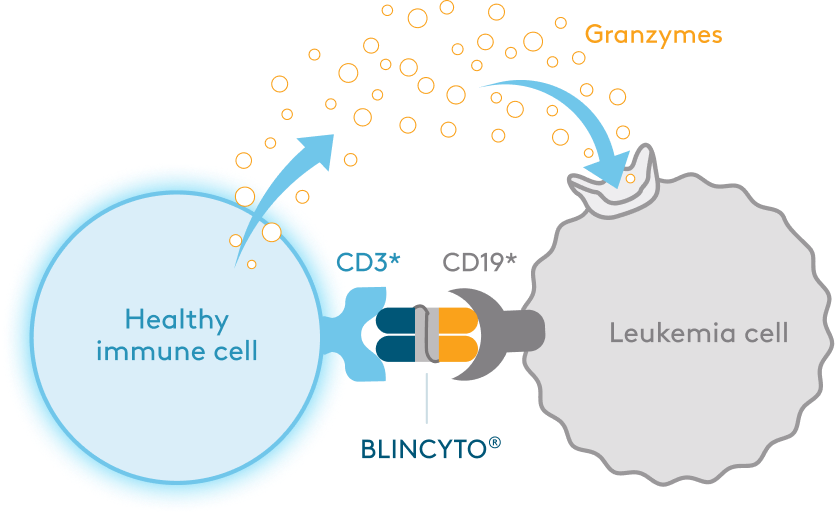
How BLINCYTO® works7

FINDS

cells can hide from healthy immune cells. BLINCYTO® helps healthy immune cells find leukemia cells and bring them together.1,7

ACTIVATES

When the healthy cells and cells are connected, BLINCYTO® activates the healthy immune cells to release specialized proteins called granzymes.7

KILLS

The granzymes then attack and kill the  cells.7

*CD3 and CD19 are targets that help BLINCYTO® find and identify healthy immune cells and leukemia cells.1,7

How BLINCYTO® works in the body
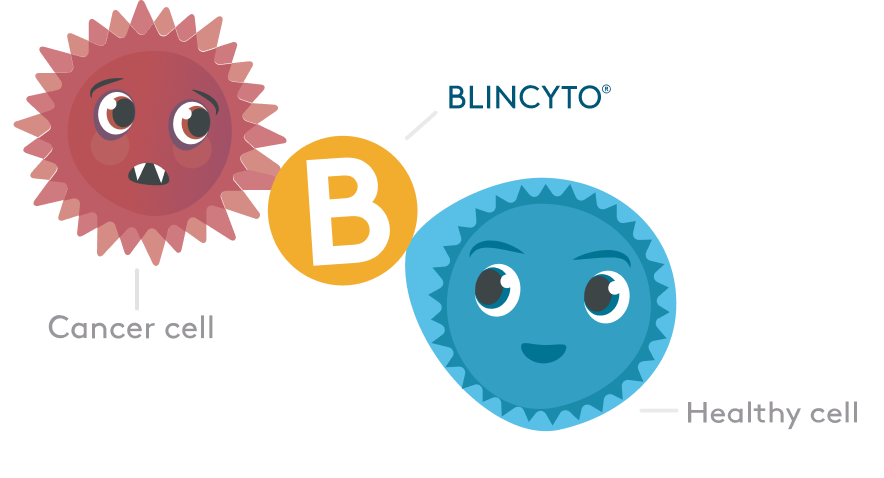
cartoon showing how BLINCYTO® helps a healthy cell find and connect to a cancer cell

BLINCYTO® is a medicine that your doctor may use to treat your. It is different from . It works with the cells in your body. BLINCYTO® helps the healthy cells find and get rid of the cells.1,2

How BLINCYTO® works:
for pediatric patients

Ask your doctor if adding BLINCYTO® to your treatment plan
after initial treatment (at consolidation) is right for you.

Why your MRD status matters

Even when you are in , small amounts of disease may remain. That’s why your doctor may test you for , or .2

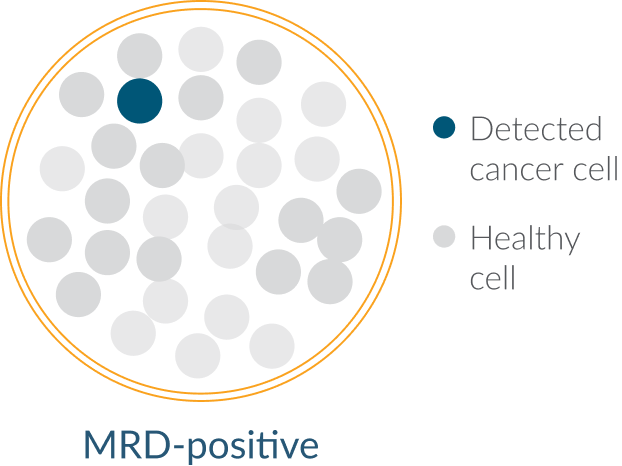
MRD-positive diagram showing remaining cancer cells among healthy cells
MRD-positive

Even after achieving with , there could still be some underlying disease. This is known as 
-positive.2,4

It is good to know your MRD status, because can increase the risk of a —which is when the signs and symptoms of your return after a period of improvement.2,4

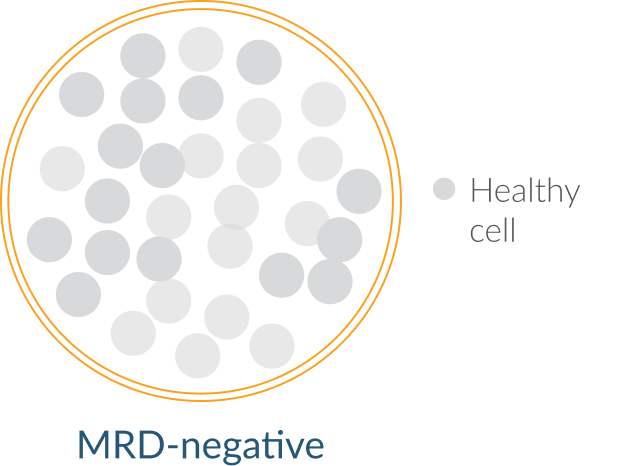
MRD-negative diagram showing no detectable cancer cells among healthy cells
MRD-negative

Your test may also show that you are -negative. This means no cancer cells can be detected, which is a good thing, but there could still be some underlying disease.2

However, there is a risk of even if you are -negative, so knowing your status is still important.2,4

Why you should know about MRD

Even though you may feel better, your doctor may still test you to see if you have a small amount of cancer left. This small amount of cancer is called , which can increase the risk of . means your cancer has come back.1,2,4,6

Why BLINCYTO®?

The good news is that BLINCYTO® has been proven to help people with different types of live longer—whether you are -positive or -negative.1

Read on to see how BLINCYTO® can help:8

  • People with –negative [Ph(–)] who’ve had initial therapy and are now in the next phase of treatment ()
  • People whose is in , but still have detectable traces of cancer ) after
  • People with whose cancer has returned (relapsed) or did not respond to treatment ()
SUMMARY

Learn about acute lymphoblastic leukemia (ALL), remission, minimal residual disease (MRD) status, and how BLINCYTO® (blinatumomab) treatment works differently than chemotherapy. A special section is provided to help you talk to kids.

Important Safety Information

What is the most important information I should know about BLINCYTO®?

  • Call your health care provider or get emergency medical help right away if you get any of the symptoms listed below:
    • BLINCYTO® may cause serious side effects that can be severe, life-threatening, or lead to death, including:
      • Cytokine Release Syndrome (CRS) and infusion reactions. Symptoms of CRS and infusion reactions may include: fever, tiredness or weakness, dizziness, headache, low blood pressure, nausea, vomiting, chills, face swelling, wheezing or trouble breathing, and skin rash.
      • Neurologic problems. Symptoms of neurologic problems may include: seizures, difficulty in speaking or slurred speech, loss of consciousness, trouble sleeping, confusion and disorientation, loss of balance, headache, difficulty with facial movements, hearing, vision, or swallowing, and tremors. People with Down Syndrome may have a higher risk of seizures with BLINCYTO® treatment and may be given anti‑seizure medicine before starting BLINCYTO® treatment.
    • Your health care provider will check for these problems during treatment with BLINCYTO®. Your health care provider may temporarily or completely stop your treatment with BLINCYTO® if you have severe side effects.

Who should not receive BLINCYTO®?

  • Do not receive BLINCYTO® if you are allergic to blinatumomab or to any of the ingredients of BLINCYTO®.

Before receiving BLINCYTO®, tell your health care provider about all of your medical conditions, including if you or your child:

  • have a history of neurological problems, such as seizures, confusion, trouble speaking or loss of balance
  • have Down Syndrome
  • have an infection
  • have ever had an infusion reaction after receiving BLINCYTO® or other medications
  • have a history of radiation treatment to the brain, or chemotherapy treatment
  • are scheduled to receive a vaccine. You should not receive a “live vaccine” within 2 weeks before you start treatment with BLINCYTO®, during treatment, and until your immune system recovers after you receive your last cycle of BLINCYTO®. If you are not sure about the type of vaccine, ask your health care provider.
  • are pregnant or plan to become pregnant. BLINCYTO® may harm your unborn baby. Tell your health care provider if you become pregnant during treatment with BLINCYTO®.
    • If you are able to become pregnant, your health care provider should do a pregnancy test before you start treatment with BLINCYTO®.
    • Females who are able to become pregnant should use an effective form of birth control (contraception) during treatment with BLINCYTO®, and for 48 hours after your last dose of BLINCYTO®.
  • are breastfeeding or plan to breastfeed. It is not known if BLINCYTO® passes into your breast milk. You should not breastfeed during treatment with BLINCYTO® and for 48 hours after your last dose.

Tell your health care provider about all the medicines you take, including prescription and over-the-counter medicines, vitamins, and herbal supplements.

What should I avoid while receiving BLINCYTO®?

  • Do not drive, operate heavy machinery, or do other dangerous activities while you are receiving BLINCYTO® because BLINCYTO® can cause neurological symptoms such as dizziness, seizures, and confusion.

BLINCYTO® may cause serious side effects, including:

  • Infections. BLINCYTO® may cause life-threatening infections that may lead to death. Tell your health care provider right away in case you develop any signs or symptoms of an infection.
  • Tumor Lysis Syndrome (TLS). TLS is caused by the fast breakdown of cancer cells. TLS can be life-threatening and may lead to death. Tell your healthcare provider right away if you have any symptoms of TLS during treatment with BLINCYTO®, including: nausea and vomiting, confusion, shortness of breath, irregular heartbeat, dark or cloudy urine, reduced amount of urine, unusual tiredness, muscle cramps.
  • Low white blood cell counts (neutropenia). Neutropenia is common with BLINCYTO® treatment and may sometimes be life-threatening. Low white blood cell counts can increase your risk of infection. Your health care provider will do blood tests to check your white blood cell counts during treatment with BLINCYTO®. Tell your health care provider right away if you get a fever.
  • Abnormal liver blood test. Your health care provider will do blood tests to check your liver before you start BLINCYTO® and during treatment with BLINCYTO®.
  • Inflammation of the pancreas (pancreatitis). Pancreatitis may happen in patients treated with BLINCYTO® and corticosteroids. It may be severe and lead to death. Tell your health care provider right away if you have severe stomach-area pain that does not go away. The pain may happen with or without nausea and vomiting.
  • Your health care provider will do blood tests during treatment to check for side effects.

The most common side effects

  • The most common side effects of BLINCYTO® include:
  • Fever
  • Reactions related to infusion of the medicine such as face swelling, low blood pressure, and high blood pressure (infusion-related reactions)
  • Headache
  • Infection
  • Muscle, joint, and bone pain
  • Low white blood cell count (neutropenia)
  • Nausea
  • Low red blood cell count (anemia)
  • Low platelet count (thrombocytopenia)
  • Diarrhea

These are not all the possible side effects of BLINCYTO®.

Call your health care provider for medical advice about side effects. You may report side effects to FDA at 1-800-FDA-1088.

Please read the accompanying Medication Guide before you or your child receives BLINCYTO® and before each BLINCYTO® infusion and discuss it with your doctor.

Please see BLINCYTO® full Prescribing Information, including BOXED WARNINGS and Medication Guide.

References:
  • 1. BLINCYTO® (blinatumomab) prescribing information, Amgen.

  • 2. National Cancer Institute. NCI dictionary of cancer terms. https://www.cancer.gov/publications/dictionaries/cancer-terms. Accessed April 17, 2026.

  • 3. Children’s Hospital of Philadelphia. Acute Lymphoblastic Leukemia (ALL). https://www.chop.edu/conditionsdiseases/acute-lymphoblastic-leukemia-all. Accessed April 17, 2026.

  • 4. Brüggemann M, Gökbuget N, Kneba M. Acute lymphoblastic leukemia: monitoring minimal residual disease as a therapeutic principle. Semin Oncol. 2012;39:47-57.

  • 5. Litzow MR, Sun Z, Mattison RJ, et al. Blinatumomab for MRD-negative acute lymphoblastic leukemia in adults. N Engl J Med. 2024;391:320-333.

  • 6. Gupta S, Rau RE, Kairalla JA, et al. Blinatumomab in standard-risk B-cell acute lymphoblastic leukemia in children. N Engl J Med. 2025;392:875-891.

  • 7. Nagorsen D, Baeuerle PA. Immunomodulatory therapy of cancer with T cell-engaging BiTE antibody blinatumomab. Exp Cell Res. 2011;317:1255-1260.

  • 8. BLINCYTO® (blinatumomab) medication guide, Amgen.